
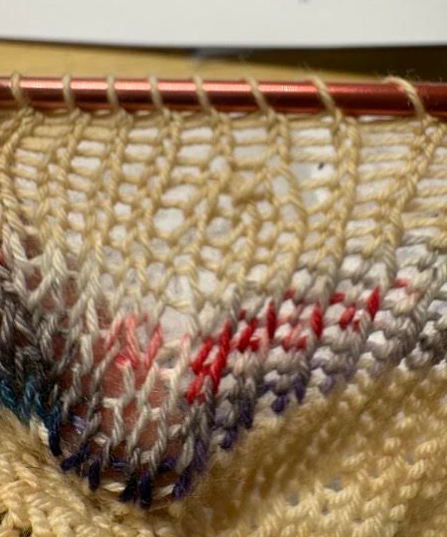
Knitting is complicated. I don't mean that it is difficult. You can pick up a pair of needles and some yarn and, with some basic instructions, make a simple swatch of knitted fabric. But sometimes things go wrong. You might poke your needles through at the wrong place and you're really not sure what you did or how to correct it. Or you set a project down and when you come back to it, you're not sure what stitches you have in front of you. Was that a purl row or a knit row? Are my stitches too loose? Too tight? Why are my fingers cramping?
An experienced knitter can often look and see exactly what has happened. To inexperienced knitters, or to people just admiring someone else's knitting, the loops coming together and looking smooth is something that seems to happen magically.
As I have stumbled through several knitting projects, I've thought about how similar knitting is to following Jesus. Some people are really good at it. Some people are just starting to take it on. For almost everyone, there is some level of mystery to it.
In knitting, one of the most frustrating things you can do is drop a stitch. If you don't catch it right away, that single missed loop can unravel all the way down your work. It feels disastrous. In our daily walk of faith, we drop stitches all the time. We lose our patience, we forget to love our neighbor, or we isolate ourselves when things get hard.
But here is the beautiful reality of God’s love: God is the Master Knitter, and God’s grace is boundless. When we make a mistake, God doesn't look at our dropped stitches, declare us ruined, and throw the whole project in the trash. Instead, with infinite patience, God meets us right where we unraveled. God gently picks up those loose loops and weaves them right back into the fabric of our lives. What we see as a glaring mistake, God is able to redeem and work into a beautiful, textured pattern.
Knitting also teaches us a profound lesson about the church. A skein of yarn is just a messy pile of string until it is intentionally looped together. A single, isolated stitch cannot keep anyone warm, but thousands of them holding onto one another can become a thick, comforting sweater or a blanket. When my own faith feels too loose or too tight, or when my hands are just too tired to keep going, I rely on the stitches right next to me to hold the tension. That is what we do for each other in community. We hold each other together when the world tries to pull us apart.
The beautiful mystery of knitting—and the mystery of following Jesus—is that we don't have to understand every complex technique to be wrapped in the final product. God's love covers us exactly as we are: imperfectly knitted, occasionally confused, yet deeply, profoundly cherished.
How can you be a stitch in community? What dropped stitches can you help to pick up?
Yours in the journey,
John